Business Facilities in Guest Houses – Boosting Guest Satisfaction


More than 60 percent of british guest house travellers in Elgin now expect business facilities that rival larger hotels. With the shift toward remote work and blended leisure stays, providing advanced amenities can set your property apart in Scotland’s competitive hospitality scene. This overview breaks down how creating functional business spaces boosts guest satisfaction and elevates operational efficiency, tailored for hospitality managers aiming to strengthen their guest houses.
Table of Contents
Key Takeaways
Point | Details |
Integration of Business Facilities | Guest houses should offer a blend of technological infrastructure, meeting spaces, and workspace solutions to cater to modern travellers’ needs. |
Compliance with Legal Standards | Ensuring adherence to fire safety and health regulations is vital for guest safety and operational excellence. |
Strategic Financial Management | Guest house operators must perform regular financial reviews and avoid common pitfalls like inadequate forecasting and poor cash flow management. |
Continuous Improvement and Adaptation | Conducting quarterly reviews of facilities and integrating new technologies are essential for staying competitive in the hospitality market. |
Defining Business Facilities in Guest Houses
Business facilities in guest houses represent a comprehensive suite of amenities and services designed to support professional and leisure travellers while delivering a distinctive hospitality experience. These facilities go beyond basic accommodation, transforming guest houses into versatile spaces that cater to modern travellers’ multifaceted needs. Fire safety requirements form a critical foundation for these operational standards.
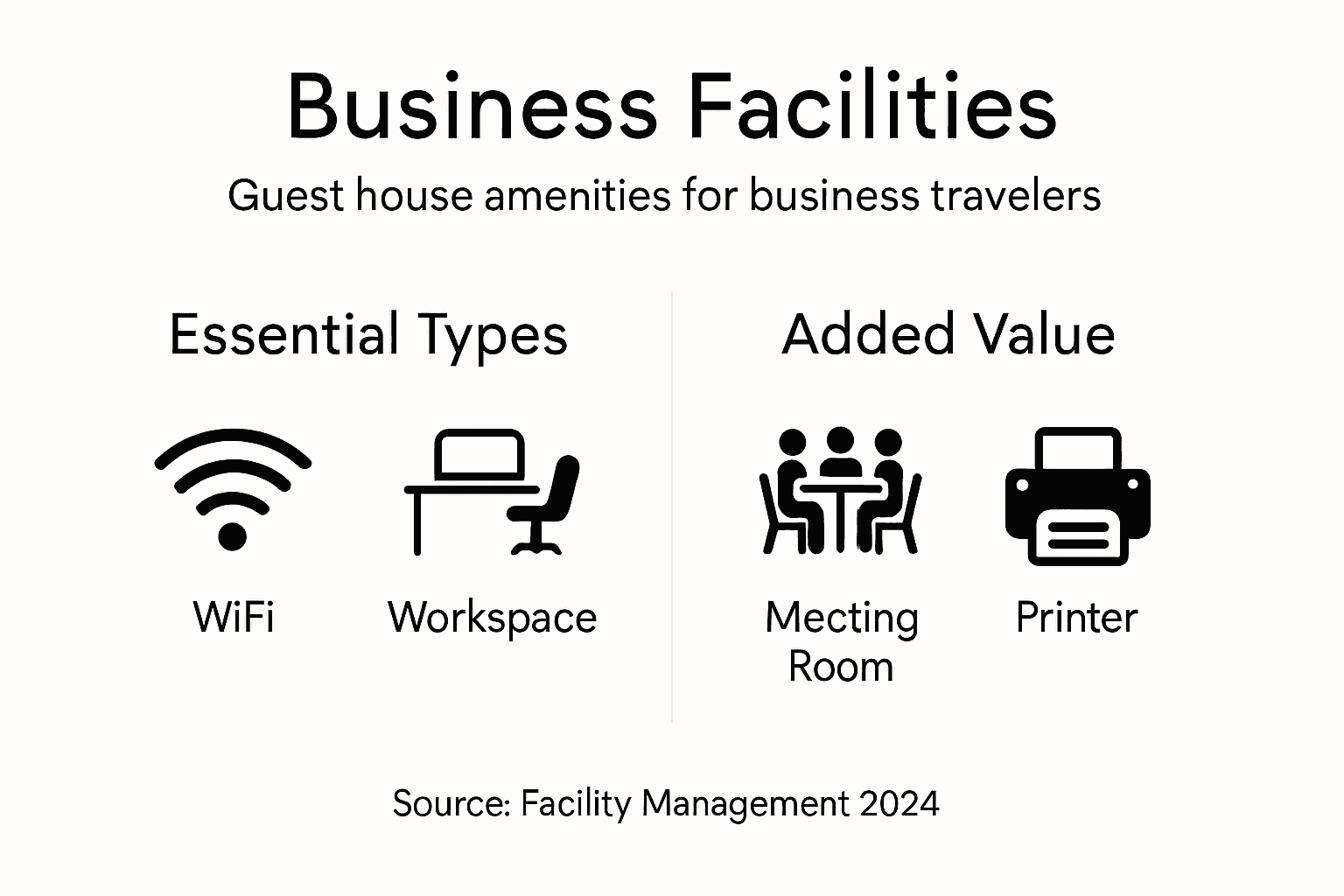
Key business facilities typically encompass several strategic categories that enhance guest satisfaction and operational efficiency. These include technological infrastructure like high-speed internet connectivity, dedicated workspace areas, printing and scanning capabilities, meeting rooms or conference spaces, and secure business equipment storage. Boutique hospitality attributes suggest that these facilities should be seamlessly integrated into the overall guest experience, reflecting the unique character of the establishment.
The configuration of business facilities varies depending on the guest house’s size, target market, and strategic positioning. Smaller guest houses might offer compact workstations with basic technological support, while larger establishments could provide fully equipped meeting rooms with advanced audiovisual systems. The key is creating flexible spaces that can transition between professional and relaxation environments, acknowledging that modern travellers often blend work and leisure requirements.
Pro tip: Conduct a quarterly review of your business facilities to ensure they remain contemporary, functional, and aligned with emerging traveller expectations.
Below is a comparison of business facilities available in guest houses of different sizes:
Facility Type | Small Guest House | Large Guest House |
Internet Connectivity | Basic Wi-Fi | High-speed fibre broadband |
Workspace Provision | Compact desk in guest room | Dedicated co-working areas |
Meeting Space | None or small lounge | Fully equipped meeting rooms |
Business Equipment | Minimal, portable devices | Advanced printing/scanning |
Storage Options | Limited personal lockers | Secure, monitored storage |
Types of Business Facilities for Hospitality
Business facilities in hospitality encompass a diverse range of strategic amenities designed to support professional and leisure guests across different operational contexts. Smart hospitality technologies have dramatically transformed how these facilities are conceived, implemented, and managed in modern guest accommodations.
The primary categories of business facilities typically include technological infrastructure, meeting spaces, workspace solutions, and communication support systems. These facilities are strategically designed to address the multifaceted needs of contemporary travellers who frequently blend professional responsibilities with leisure activities. Hospitality facility classifications reveal several key typologies that guest houses can integrate:
Accommodation-based Facilities: Private workstations within guest rooms
Shared Business Centers: Communal spaces with advanced technological equipment
Meeting and Conference Rooms: Flexible spaces for professional interactions
Digital Communication Zones: High-speed internet and connectivity areas
Equipment Support Facilities: Printing, scanning, and secure storage solutions
The effectiveness of these business facilities depends on their seamless integration, technological adaptability, and ability to provide personalised experiences. Guest houses must continually evolve their offerings to match changing professional and technological landscapes, ensuring they remain competitive and attractive to discerning business travellers.
Pro tip: Invest in modular business facility designs that can be quickly reconfigured to accommodate diverse guest requirements and emerging technological trends.
Management and Integration for Efficiency
Effective management and integration of business facilities require a sophisticated approach that balances technological innovation with strategic operational planning. AI and IoT technologies have emerged as transformative tools for guest houses seeking to optimise their business infrastructure, enabling more intelligent and responsive service delivery.

The integration process involves several critical dimensions that guest house managers must carefully navigate. These include technological infrastructure alignment, staff training, data management systems, and adaptive service protocols. Digital innovation strategies emphasise the importance of creating flexible systems that can seamlessly incorporate emerging technologies while maintaining the human touch that distinguishes personalised hospitality experiences.
Key strategic approaches for efficient management include:
Implementing cloud-based management systems
Developing real-time performance tracking mechanisms
Creating cross-functional technological training programmes
Establishing data-driven decision-making frameworks
Integrating adaptive customer relationship management tools
Successful implementation requires a holistic approach that views technological integration not as a replacement for human interaction, but as a sophisticated enhancement of service capabilities. Guest houses must continually reassess and recalibrate their technological ecosystems to remain competitive and responsive to evolving guest expectations.
For easy reference, here is a summary of strategic approaches for efficiently managing business facilities:
Approach | Main Objective | Business Impact |
Cloud-based management systems | Streamline operations | Increases agility and efficiency |
Real-time performance tracking | Monitor facility usage | Enhances resource optimisation |
Technological staff training | Upskill employees | Improves guest service quality |
Data-driven decision frameworks | Inform business strategy | Facilitates proactive improvements |
Pro tip: Conduct biannual technology audits to identify integration opportunities and potential efficiency improvements across your business facilities.
Legal and Safety Standards for Facilities
Guest house operators must navigate a complex landscape of legal and safety standards that ensure guest protection and regulatory compliance. Fire safety regulations represent a critical cornerstone of these requirements, mandating comprehensive risk assessment and proactive safety management across all operational domains.
The legal framework for guest house facilities encompasses multiple critical dimensions, including health and safety protocols, infrastructure standards, and guest welfare provisions. Comprehensive facility guidelines typically cover essential areas such as:
Fire protection systems
Emergency evacuation procedures
Structural safety requirements
Sanitation and hygiene standards
Accessibility infrastructure
Environmental compliance measures
Successful implementation requires a systematic approach that integrates legal compliance with practical operational strategies. Guest house managers must develop robust documentation, conduct regular safety audits, and maintain meticulous records demonstrating ongoing adherence to regulatory standards. This involves not just meeting minimum legal requirements, but proactively creating an environment that prioritises guest safety and operational excellence.
Pro tip: Develop a comprehensive compliance checklist that is reviewed and updated quarterly to ensure ongoing alignment with evolving legal and safety regulations.
Financial Impact and Common Pitfalls
Managing the financial landscape of business facilities in guest houses requires a nuanced understanding of strategic resource allocation and potential economic challenges. Financial planning strategies reveal critical insights into navigating the complex economic ecosystem of hospitality enterprises.
Common financial pitfalls that guest house operators frequently encounter include:
Inadequate budget forecasting
Inconsistent revenue management
Overinvestment in non-essential facilities
Underestimating maintenance costs
Poor cash flow management
Insufficient contingency reserves
Successful financial management demands a proactive approach that balances strategic investments with rigorous cost control. Guest house managers must develop sophisticated financial models that account for seasonal variations, technological upgrades, and unexpected operational expenses. This requires continuous monitoring of key performance indicators, regular financial audits, and a willingness to adapt financial strategies in response to changing market dynamics.
The most successful guest houses approach financial planning as a dynamic, iterative process. They integrate advanced financial tracking technologies, maintain flexible budget allocations, and consistently reassess their investment strategies to ensure optimal resource utilisation and sustained economic resilience.
Pro tip: Implement a quarterly financial review process that includes comprehensive analysis of revenue streams, operational expenses, and potential investment opportunities.
Elevate Your Guest House With Tailored Business Facilities
Discover how integrating smart business facilities can transform your guest house experience. The article highlights challenges such as balancing technological infrastructure, meeting spaces, and legal safety requirements while maintaining personalised hospitality. If you are striving to boost guest satisfaction by providing seamless workspace solutions and efficient management, understanding and implementing these concepts is essential.
Take the next step to enhance your guest house with innovative and flexible business facilities that meet modern traveller expectations. Visit Hotel Guest House now to explore services designed for exceptional guest experiences. Don’t miss out on turning your guest house into the preferred choice for business and leisure travellers alike.
Frequently Asked Questions
What are the essential business facilities in guest houses?
Business facilities in guest houses typically include high-speed internet connectivity, dedicated workspace areas, meeting rooms, printing and scanning capabilities, and secure equipment storage. These amenities cater to the needs of both professional and leisure travellers.
How can guest houses ensure their business facilities remain up to date?
Guest houses should conduct quarterly reviews of their business facilities to ensure they meet contemporary standards and align with emerging traveller expectations. This helps in keeping the facilities relevant and functional.
What factors influence the configuration of business facilities in a guest house?
The configuration of business facilities is influenced by the size of the guest house, the target market it caters to, and its strategic positioning. Smaller guest houses might have compact workstations, while larger ones may offer fully equipped meeting rooms.
How does the integration of technology impact business facilities in guest houses?
The integration of technology enhances the efficiency of business facilities by streamlining operations, improving guest services, and allowing for adaptations that meet current trends in hospitality. Cloud-based management systems and real-time performance tracking are examples of technology that can significantly improve service delivery.
Recommended


Comments